
Commercial Intercom Gate Release Wiring Guide: Fail-Safe vs. Fail-Secure, Dry Contact Relays & Access Power Calculations
To wire an intercom gate release correctly, use Form-C dry contact relays on the door station: configure Normally Open (NO) for Fail-Secure electric strikes (power to unlock) and Normally Closed (NC) with a dedicated power supply for Fail-Safe magnetic locks (power to hold). Always install a reverse-biased flyback diode across inductive strike coils to eliminate relay arcing and prevent PCBA microcontroller resets.
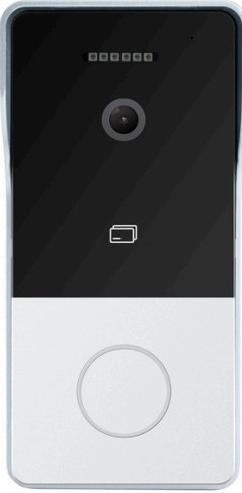
Access control actuation is the most mission-critical function of an architectural intercom system. When a resident or security guard presses the unlock button on an indoor touch monitor or smartphone app, the intercom door station must reliably unlatch physical perimeter hardware—ranging from mortise electric strikes and electromagnetic locks (maglocks) to automated heavy sliding vehicular gates.
A frequent failure in field installations is misunderstanding the fundamental distinction between Fail-Safe and Fail-Secure locking hardware. Fail-Safe hardware (predominantly electromagnetic locks and emergency exit shear locks) requires continuous electrical current to remain locked; when power is cut or an emergency fire alarm triggers, the lock releases automatically to ensure uninhibited life-safety egress. Fail-Safe locks must be wired through the intercom station's Normally Closed (NC) and Common (COM) dry contacts in series with a dedicated DC power supply. Conversely, Fail-Secure hardware (predominantly standard commercial electric strikes) remains physically locked when de-energized and requires a momentary pulse of electrical power to release. Fail-Secure strikes must be wired to the door station's Normally Open (NO) and COM contacts.
Another critical engineering hazard in gate access wiring is inductive kickback voltage (flyback EMF). Electric strike coils and gate motor solenoid relays are highly inductive loads. When the door station relay opens to de-energize the coil, the collapsing magnetic field generates a massive reverse voltage spike—often exceeding 200V to 400V across a nominal 12V DC circuit. Without suppression, this electrical transient arcs across the door station's relay contacts, welding the contacts shut over time and broadcasting high-frequency electrical noise that causes microcontroller resets and corrupted video streams on the local intercom bus. 1 Karat door stations integrate built-in optocoupler galvanic isolation, but installers must always install a reverse-biased diode (such as a standard 1N4004 or 1N4007) directly in parallel across the electric strike terminals to absorb the inductive surge at the source.
Voltage drop along extended perimeter cable runs is the third most common cause of intermittent gate latch failure. While IP data signals transmit reliably up to 100 meters over Cat5e/Cat6 UTP cable, powering a 12V DC electric strike drawing 500mA to 800mA over a 50-meter 24 AWG network pair causes a catastrophic voltage drop exceeding 2.8V, leaving the lock with insufficient torque to release under latch bolt side-pressure. For runs exceeding 30 meters, electrical engineers should specify minimum 18 AWG (0.82 mm²) or 16 AWG (1.31 mm²) stranded copper conductors for the lock power circuit, or position a dedicated supervised power supply enclosure adjacent to the gate controller.
1 Karat commercial door stations (such as the KA-FV5208, KA-FV5204, and KA-FV5203) feature dual independent Form-C dry-contact relays rated at 30V DC / 2A. Relay 1 provides sub-35 millisecond latch release for the primary pedestrian electric strike, while Relay 2 provides a clean momentary closure output to trigger vehicular gate automation controllers (such as FAAC, BFT, or LiftMaster) without requiring external interposing relays.
1 Karat Engineering Lab: Relay Actuation & Contact Durability Benchmarks
Architectural Comparison Matrix
| Specification & Engineering Factor | Fail-Secure Electric Strike (NO) | Fail-Safe Magnetic Lock (NC) | Motorized Vehicular Gate (Dry Pulse) |
|---|---|---|---|
| Intercom Relay Terminal | Normally Open (NO) + COM | Normally Closed (NC) + COM | Normally Open (NO) + COM (Dry Contact) |
| Behavior on Power Outage | Remains LOCKED (High Physical Security) | Releases UNLOCKED (Life Safety / Fire Exit) | Remains in current state / manual clutch |
| Operating Power Draw | 0 mA standby / 450-800 mA unlock pulse | 350-500 mA continuous holding power | 0 mA dry loop / gate uses internal board power |
| Inductive Flyback Diode Needed? | MANDATORY (1N4004 across strike coil) | MANDATORY (Diode or MOV surge suppressor) | Not needed (Isolated low-voltage logic trigger) |
| Recommended Wire Gauge (30m+) | 18 AWG stranded copper pair (Min 1.0mm²) | 18 AWG stranded copper pair (Continuous) | 22 AWG or Cat5e twisted pair (Logic signal) |
| Typical Architectural Application | Commercial entrances, apartment front doors | Glass doors, stairwell emergency exits | Subdivision driveway gates, villa sliding barriers |
Frequently Asked Technical Questions
What is the difference between dry contact and wet contact on an intercom door station?
A dry contact relay acts as an isolated mechanical switch with no internal voltage output (COM, NO, NC); it requires an external power supply to power the lock or simply closes a low-voltage circuit on a gate controller. A wet contact supplies voltage directly from the intercom's internal power supply. 1 Karat door stations use dry contacts to ensure universal compatibility with any 12V, 24V, or dry gate automation system without risk of back-feeding voltage.
Why should an installer never power a heavy magnetic lock directly from the intercom's PoE budget?
While IEEE 802.3af PoE provides up to 15.4W to power the intercom's camera, processor, and night-vision LEDs, driving a 500mA maglock or high-torque electric strike from the same line causes voltage dips during unlock spikes, which can trigger intercom reboots or Wi-Fi disconnection. Always use a dedicated, battery-backed 12V DC power supply for the locking hardware.
How do residents release the gate when receiving a call via SIP 2.0 or Tuya mobile app?
When a visitor calls from the outdoor station, the resident can unlatch the gate by tapping the unlock icon on the in-wall master screen or Tuya mobile app. For SIP 2.0 PBX integration, pressing a configurable DTMF key (typically '*' or '#') during the call sends an RFC 2833 or SIP INFO tone that instantly triggers the door station relay.
Featured Hardware for this Architecture
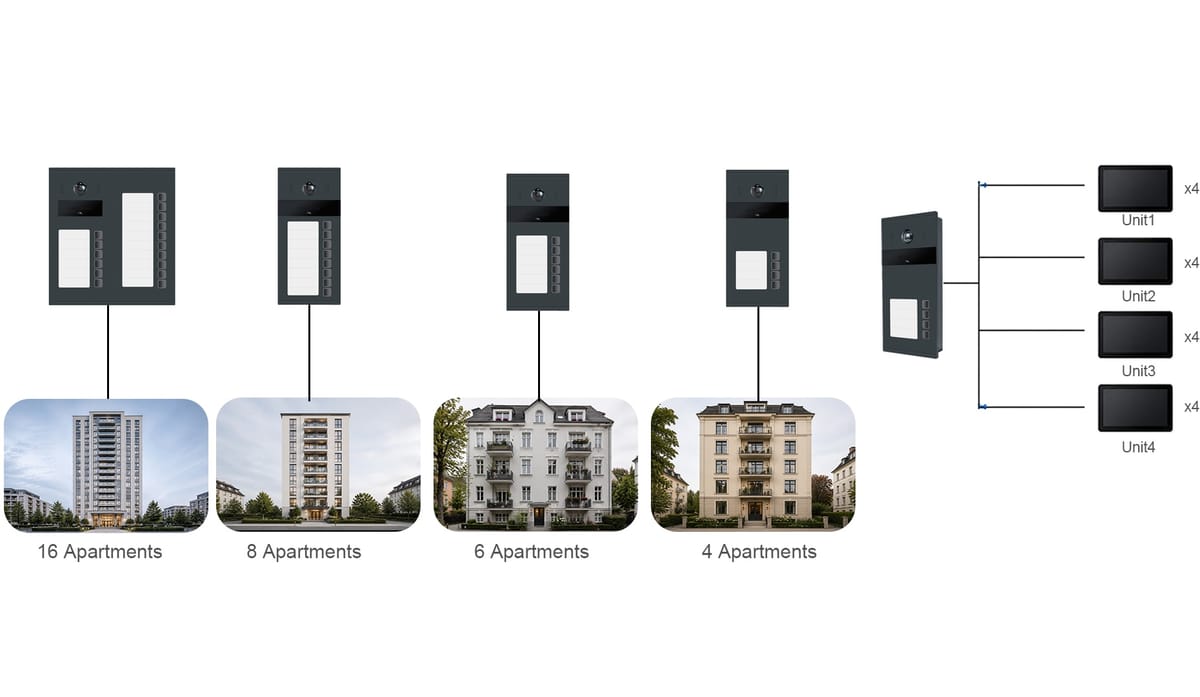
KA-FV5208 Series - Apartment Face ID Door Station
Commercial 2K TCP/IP PoE apartment intercom station with dual gate relays and Face ID.
KA-FV5204 - Luxury Villa Door Station
2K 148° PoE villa entrance station with dual independent gate release relays.
KA-FV5203 - Architectural Door Station
Aircraft-grade aluminum IP65 outdoor intercom station with motorized gate integration.
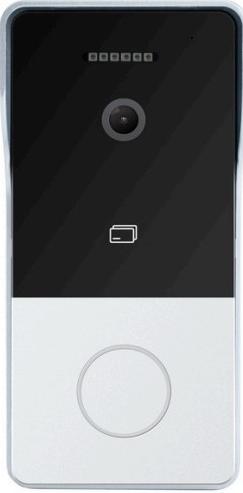
KA-FV2204 - 2-Wire Villa Door Station
Non-polarized 2-wire retrofit outdoor station with onboard electric lock release relay.
Planning a Commercial or Residential Project?
Contact 1 Karat's solution architects for custom wiring diagrams, sample kit requests, and OEM/ODM manufacturing partnerships.